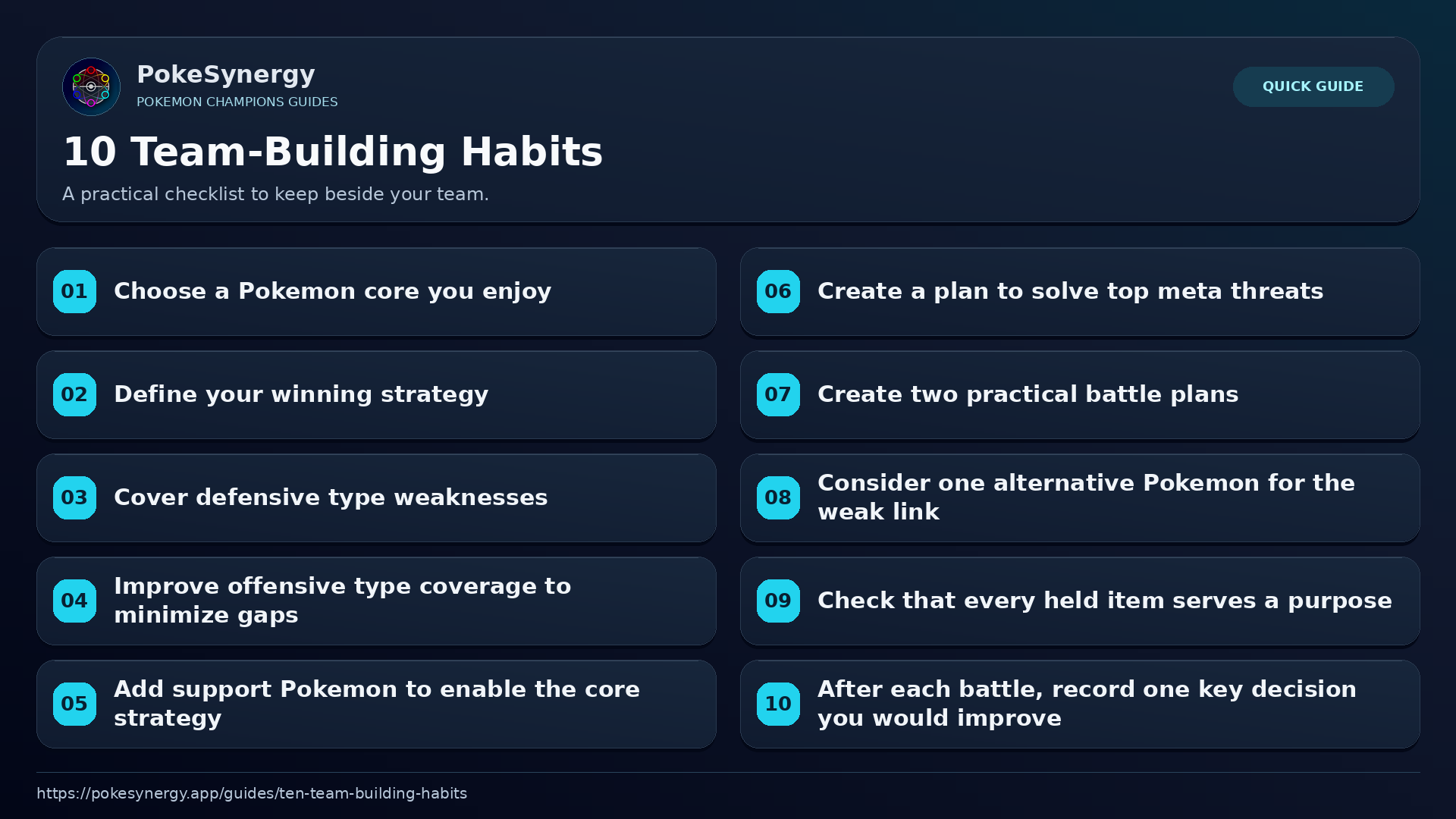
10 habits for building a Pokemon Champions team
Use these ten habits to give each team slot a purpose, practice a clear plan and make changes you can explain. Work through the first nine while building, then use the final habit after each battle.
Keep the printable reference beside you as a reminder. The examples below focus on Doubles; support choices and gameplans should fit the format you actually play.
By Scoriox · Published September 5, 2026
1. Choose a Pokemon core you enjoy
Start around a favourite Pokemon, an archetype you like, or a familiar Fire/Water/Grass core. Choose Pokemon that work together so the remaining slots have a clear job to fill.
2. Define your winning strategy
Write down how the core wins and what needs to happen first. Hyper Offense might aim to remove a key threat and overwhelm the remaining team. A setup strategy needs a way to create a safe turn for its attacker.
3. Cover defensive type weaknesses
Check the core's shared weaknesses before filling the remaining slots. Look for partners that can resist, absorb or discourage the attacks your core struggles with. Recheck as the team develops: solving one gap can introduce another.
4. Improve offensive type coverage to minimize gaps
Check which types your selected attacks can hit super effectively. Try a small move change before replacing a Pokemon that already fills an important role. Broad coverage is a useful aim, but actual matchups also depend on abilities, damage and getting a turn to attack.
5. Add support Pokemon to enable the core strategy
Choose support for the plan you wrote down. Tailwind or Trick Room can provide speed control; redirection or healing can help a setup attacker; Fake Out and positioning can help maintain weather. A team relying on spread attacks also needs a plan for Wide Guard.
Give that Pokemon enough staying power to do its job. Check whether Helping Hand, Taunt, Protect or another support action contributes more than extra damage investment.
6. Create a plan to solve top meta threats
Use a current list for your chosen format, then ask how your team handles each Pokemon. Keep a short list of threats you struggle to answer. Use those gaps to guide the final slot instead of adding a Pokemon without a clear purpose.
MetaDex gives tournament context; the builder's selected usage source gives its own view of the format. Keep the source and regulation in mind when choosing which threats to review.
7. Create two practical battle plans
Identify two repeatable ways to use the team, such as a Mega setup, an aggressive lead or a safer pivoting approach. Practicing those plans reduces the number of decisions you need to invent each game. Track where they work and where a matchup forces you to adapt.
8. Consider one alternative Pokemon for the weak link
Look for a slot whose type or role overlaps without adding enough value. Consider a Pokemon that covers a missing type or performs the required role better. Duplication is a prompt to review the slot, not proof that it must be replaced.
9. Check that every held item serves a purpose
Review each item against how you actually use its holder. A Focus Sash may be a poor fit for a Pokemon that often switches into damage. Check whether Sitrus Berry helps a defensive piece survive, whether Life Orb changes a useful damage benchmark, and whether Choice Scarf and Speed SP achieve the speed targets you need.
10. After each battle, record one key decision you would improve
Pick one key decision you would improve. It might be your lead, a Protect or a switch. Write what happened, what you would choose differently, and why. Keep it short enough that you will do it again.
Save these notes in a simple document. After 100 battles, review the patterns to decide what to practice or change. You do not need to analyse every turn to learn something useful.