
How PokeSynergy chooses a Battle AI action
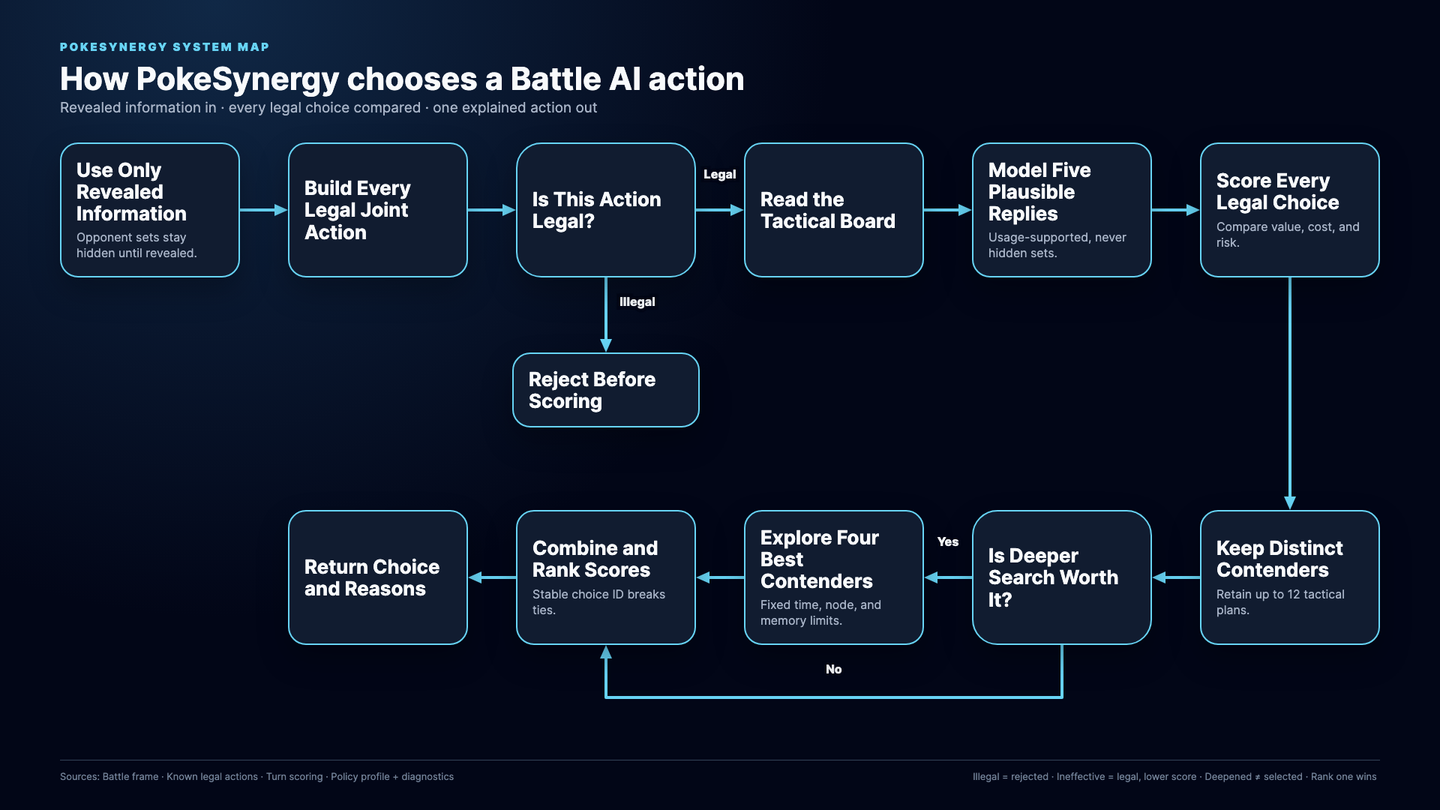
PokeSynergy starts only from what the acting side can know, scores every legal joint action against plausible opponent actions, spends extra simulation only on tactically distinct close decisions, then returns a deterministic choice with an auditable score breakdown.
Scope and inputs
Intended reader: Competitive Pokémon players who understand turns, moves, switching, and hidden information but not search algorithms.
Revealed information in · every legal choice compared · one explained action out.
Follow the stages below. Branches name their destination; a loop returns to the named stage.
Stages and branches
Use Only Revealed Information
Opponent sets stay hidden until revealed.
- Continue: Build Every Legal Joint Action
Build Every Legal Joint Action
- Continue: Is This Action Legal?
Is This Action Legal?
- Legal: Read the Tactical Board
- Illegal: Reject Before Scoring
Read the Tactical Board
- Continue: Model Five Plausible Replies
Model Five Plausible Replies
Usage-supported, never hidden sets.
- Continue: Score Every Legal Choice
Score Every Legal Choice
Compare value, cost, and risk.
- Continue: Keep Distinct Contenders
Reject Before Scoring
Keep Distinct Contenders
Retain up to 12 tactical plans.
- Continue: Is Deeper Search Worth It?
Is Deeper Search Worth It?
Explore Four Best Contenders
Fixed time, node, and memory limits.
- Continue: Combine and Rank Scores
Combine and Rank Scores
Stable choice ID breaks ties.
- Continue: Return Choice and Reasons
Return Choice and Reasons
Outputs
- Return Choice and Reasons
Limits and uncertainty
- Illegal = rejected · Ineffective = legal, lower score · Deepened ≠ selected · Rank one wins
- Rejected by the request/protocol boundary or absent from the legal set; never a score band.
- Still legal, but exposure, weak progress, repetition, or setup risk lowers its score.
- Evaluated but not deterministic rank one; shallow alternatives may become ineligible after deep search.
- Received bounded continuation; this does not guarantee selection or perfect play.
What this does not prove
A bounded evaluation is not perfect-play proof or a guarantee of results outside its declared protocol.
Glossary
- joint action
- both active Pokémon's choices taken together
- hypothesis
- a weighted plausible opponent action, not hidden knowledge
- policy selection probability
- the deterministic policy's rank-one selection, not win probability
Sources and review
Reviewed for publication . Source observations retain their original dates.
- Battle frame · observed 2026-08-27
- Known legal actions · observed 2026-08-27
- Turn scoring · observed 2026-08-27
- Policy profile + diagnostics · observed 2026-08-27
Source references and revision
Source SHA-256: 2a8f960d037b7add4a076af8fce68d28a05c5542b5b79bb0fd9c50426bf9c5f5
- Battle frame: src/server/battle/championsBattleProtocol.ts; src/domain/battle/protocol.ts
- Known legal actions: src/server/battle/policy/knowledge.ts; src/server/battle/policy/legalCandidates.ts
- Turn scoring: src/server/battle/policy/turnPolicy.ts; src/server/battle/policy/scoring.ts; src/server/battle/policy/boardEvaluation.ts
- Policy profile + diagnostics: src/server/battle/championsBattlePolicyProfile.ts; src/domain/battle/diagnostics.ts